The
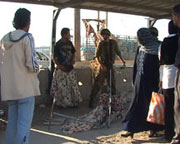
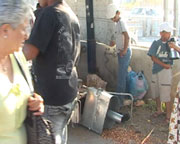
abuse of Qalandiya's vendors
Every day, sometimes a few times a day, they embark upon
their voyages with pointed butts, and diligent enthusiasm, usually three
or two together, they pass by the carts and thrust the goods to the
ground, stamping them with their feet, or sometimes they will beat the
vendor, with their hands, or using their rifles' butts; mostly they
don't warn them first, because why would they give up the pleasure of
the hunt.
All this, with great 'loyalty' to their duty.
It's not the only wrong doing, the primary or the worst
one. But it exposes with chilling accuracy, Occupation - its goals, not
the overt, official ones, and the slime that has pervaded everything.
The Israeli "Defense" Army systematically, consistently,
diligently and proudly abuses the vendors. All over the West
Bank, wherever they are, the soldiers hunt them down, following orders.
Who are they? they who have nothing to eat, who mostly
used to have another profession, however no more, because of Occupation,
because of checkpoints, because of not being allowed into Israel. most
of them breadwinners of big families, most of them have no choice,
because if they had, they wouldn't have submitted themselves to being
subjected to all this darkness, all this corruption and racism and
obtuseness and militancy and the lust for abuse for its own sake. All
that is the essence of serving Occupation.
They are beaten, their goods are trampled, their wagons
are turned over……… mostly by soldiers, not particular ones….. in these
years, the abusers were from different units, wear different shoes, and
are of different ages. However the abuse of the vendors steadily
continues all the time.
It was about three years ago. A 'herd of soldiers' went
to the southern square of Qalandiya checkpoint and smashed a shed built
at the side of the road, where a seller of vegetables protected his
merchandise against the rain. I called the army. The one who answered me
was then the commander's assistant who belonged to the army's spokesmen
unit. Her name I think was tamar. She investigated; well, how could she
not/of course she would, my 'stainless' Hebrew (no accent), shows my
origin; therefore, I have an identity, and a face, therefore, I am a
person and not a stereotype, therefore my opinion counts, even if with
reservation. So she returned with what was then the official reason:
according to the Mandatory law, she explained to me, it is forbidden to
peddle at the side of the road. That's why the soldiers smashed the
shed, she concluded as if what she had said was an answer….
Another time, it was the northern side of Qalandiya
checkpoint, soldiers were running down the market stalls. There were
books, artificial flowers, vegetables, toys, they knocked everything
down, trampled everything with their feet, as they always do…. I called
the army again. This time it was to the DCO hotline which is called,
strangely enough, the Humanitarian hotline (just another one of their
ways to sustain and uphold occupation.. as if the word 'humanitarian'
isn't in deep contradiction with what is intrinsically ingrained in what
is an occupying army), and I was told by a 'well mannered' 'gracious'
soldier that according to the law, they are not allowed to peddle. 'The
law?' I asked. 'A law going back to the Ottoman Ruling' he explained.
'Do you hear what you are saying' I tell the soldier at the end of the
line. 'These are people who, all they want is to make a living, why
shouldn't they?' 'But it isn't allowed', he told me' convinced.
'According to the law. The Ottoman…..
Another time, when I still used to bother calling the
army, as if any of them, sitting somewhere high or low, no matter where,
or who, are not responsible as well, to some point, to the injustice I
am reporting, still, it is a sort of method. Because it turns out that
what is allowed and desirable, like shooting at the children of
Qalandiya refugee camp while they are running away, or detaining people
for infinite amount of time, or throwing away their ids over the fence,
or just tearing them up, or not returning them, or ordering people who
had been handcuffed to sit in hole, for hours, is not always
'worthwhile' when Jewish women see. To do all this is permitted, is
welcomed, but to be seen, it turns out, is less desirable. Actually, if
to be more precise, it depends on who is the one seeing. To be seen by
Palestinians doesn’t count as to be seen. To be seen by the 'worthy',
well that is quite another issue.
Therefore, at times, it is advisable to call and say, that
we saw, that we know. To tell those who know too, so they'll tell us,
no, it isn't happening, soldiers do not shoot at children, or that no,
he isn't handcuffed, or that they didn't lose his id, or that he was the
one who started, he had a knife they say, they lie. But sometimes,
miraculously, he who has been detained for hours is released, the
handcuffed, untied, he who supposedly tried to stab a soldier with a
knife, is free to go, the id uncannily is pulled out of a soldier's
pocket, the very same soldier who insisted he didn't take the id, and
this or that man or woman will be released this time, will get through,
will live this time, until the next time….
'Because it disturbs them'. This astonishing reply was
given to me by a soldier to my regular question, why have they destroyed
the vendors' stalls. 'But them are them' I say, 'them are those who are
harassed, they don't bother themselves'. 'It bothers them' he insisted.
'Then ask them', I offered. 'No, don't give them my number', he said
apprehensively. Because it turns out the army's humanitarian hotline is
not for Palestinians. Only Jews can call it. Not the victims. That's how
it is. 'and it does bother them, he insists with an insulted, self
righteous voice. 'that is why they are forbidden/why they cannot sell
there'. As if how can I question the validity of his words…. It turns
out that within the total sum of the sins mentioned, my questioning is
the gravest one of all….
I remember another time, after one of the raids, the CP
commander explained to me why he and his fellow soldiers chase away the
vendors from the area. ' Because that way they can see them, the
soldiers, he explained. But they see you when they cross the checkpoint,
I said…
Well the occupier doesn't like contradictions. His
thinking is lucid and pure and without convolutions…. 'They will see
us', he repeated.
The vendors are not suspected of anything, not even
according to the army. They are usually not arrested, their ids are not
taken away, or checked; they are 'only' hunted, beaten, and denied
working for their living, systematically.
It was according to given orders that the soldiers and the
municipality destroy the living of hard working people who make pennies,
rob them of their livelihood, and beat them.
Because they can. Because this is Occupation. Security is
nothing but a cliche, a brand name, waved around by the Occupation's
skilled advertising office, in order to hide everything, to flatten
everything, and to allow behind the black hole with the so seductive
name of security, what Occupation is really about.
Wednesday, June 15th, 2005, very few vendors.
the leftovers of the scattered chickpeas that soldiers, yesterday, on
one of their daily bullying rounds had dispersed everywhere. It wasn't
long after we had left, just after 5.30 pm, again soldiers went out on
their bullying expedition and chose Ibrahim, one of the vendors (a
gentle, delicate looking young man, father of a baby, who sells hats and
glasses, who was standing further away on the other side of the square
close to the newly built apartheid wall) as that day's punching ball.
They hurled his cart on the floor, all its contents scattering on the
ground, and he started to flee, and they after him. As he was running
away from the soldiers a truck or some large vehicle carrying more
soldiers was just crossing the square. They immediately stopped, and
joined the 'hunt'. Eventually they caught him, about twenty soldiers,
pushed him against a soft limestone wall and started beating him, using
their hands, legs and gun butts. He started to bleed, blood was
streaming out of his head, and from his ear, all covered in blood, lying
on the ground. His father, a vendor too, arrived, and tried to interfere
and was beaten as well. Then the soldiers began shooting close to
Ibrahim's feet. Ahmed was amongst the taxi drivers that gathered around
and watched, stunned, at what was happening. He may have said something,
or asked, he told us, he couldn't exactly recall how it began, only
that, eventually, he dared and asked why they were doing this to him,
and, a soldier, one of those who weren't beating Ibrahim, at the moment,
turned towards him, and with the pointed butt of his gun, ran towards
Ahmed and beat him on the side of his head, by the ear, as he crouched,
and then fell down, when a few more soldiers joined him and started
beating him (Ahmed) too, for a while.
Meanwhile, the soldiers lifted the bleeding vendor and
flung him onto the street, shot a few more shots into the air, a finale,
and left.
hursday afternoon, June 16th, tension in the
air. Apprehension. Some vendors place themselves as far away from the
checkpoint as possible so as to have more time to flee from the soldiers
when on their daily bullying sprees... most put less goods on their
carts because in any case there is a great chance part of it will get
damaged after the daily raid, and it is wiser to put less, and lose
less.... all together, less vendors.... some are too scared to come,
some have moved to other places, many remain at home, with stitches, or
fractures, or wounds, convalescing from the varied imprints of this
ongoing incessant abuse by the soldiers... but still, day after day,
against all odds, like the dew emerging from the grass, they are there,
to claim their right to live, because they have no choice, because they
have a choice, true rebels....
Abu Haled, Ibrahim's father, sells corn and chickpeas. His
cart stands on the southern side of the CP, in the path leading to the
CP. He has twelve children, One of the little ones helps him. He tells
us about what has happened the day before to his son, Ibrahim. How they
had gone to the hospital, and how, on the last Tuesday and Wednesday
soldiers from the CP had turned over his cart, and how all the food was
scattered. He said he wanted to file a complaint against the soldiers.
He was just consulting with us as to what to do when soldiers appeared,
all of a sudden, three of them. They arrived from the southern side,
walking with clear determination towards him, their purpose very clear,
we were there, we saw. The first one, with a wide stroke, hit the bowl
with the chickpeas which flew upwards into the air, before crashing to
the ground, all the peas splattering everywhere, onto the dirt and the
sand. Then they kicked over a small cart (a baby carriage made into a
selling stall) with peanuts, the peanuts scattering on the ground,
spreading, splashing everywhere, and the cart turned over. And, after
the chickpeas and the peanuts they went over to Yosef, a boy, who sells
colorful dresses. Just before Yosef, the eldest of a family of nine
brothers and sisters, the parents dis functional, and he is the only
bread winner, had told us, how two days before soldiers had turned over
and stamped on the clothes he sells. Told us with wet eyes... Told us
and shifted his eyes. And again, in front of our eyes, it happened
again. The soldier shoved the crossbar that the dresses were hanging on,
to the ground, his back tight and cockish and overly erect in his
masterful posture.
All the chickpeas and peanuts were dispersed on the
ground, in the sand, the clothes thrown about, and the structure they
were hanging on tilted. The soldiers still stood, looking around, no one
interfered. It was quite apparent that they would have liked to but
didn't dare and their holding back permeated the air with shame and
suppressed anger. Everything was silent. an uncanny stillness. Then Abu
Haled quietly started picking up the chickpeas from the ground. The
soldiers, took his id with them, saying 'remember what happened to your
son.... come at night (to collect his id)' and left. The child who was
selling peanuts lifted his cart, and began collecting the peanuts from
the sand, Yosef picked up the dresses, trying to no avail to rub the
dirt off. There was a kind of reserved festivity, people staring for a
moment, but then hurrying on. Then the children hanging about crouched
down too, and began helping to collect the peanuts and chickpeas from
the ground, loading them on to the carts again. It was obvious the food
would be cleaned up and sold again.