| |
We met A. from Urif, brother of N. of whom we've written often. A. used
to work in Israel until he was blacklisted and prevented from entering
and working there, like almost all Palestinians. He was still working in
spite of this until he got caught and spent several months in jail for
'illegal' sojourn inside Israel. Since his discharge, he married, and
fathered his first daughter. A few years ago he started a small
herb-garden together with his wife in their yard, and sells their
produce near the checkpoint. Then he is ordered away, and some soldiers
or others dash his plants to the ground. At times he is depressed and
nearly gives up, and then he returns.
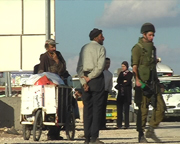
Some flowerpots were displayed on the pavement at the edge of the
taxi-park, far from the soldiers, neat and attractive. Several people
approached to take a look perhaps buy.
How are you, we asked. Today okay, he said. And in general? Okay. Only
Thursday, that's a problem. Thursday? Yes… I brought all my goods, with
my car… Half an hour later soldiers came, talked… Why isn't it clean
here. Go on everyone, go home. I tell him: What kind of a mess am I
making? Rudi's his name, I think. An officer. That's the way it is every
Thursday, then all the vendors have to go home. From tomorrow, no
stalls. And that it's not clean. He only talks about cleanliness. What's
not clean... We have a kid whom we pay to clean up. All the drivers and
the vendors. Two weeks ago, in the morning, we cleaned up the whole
taxi-park. Before people come… On other days? Other days are better, he
says. But sometimes soldiers come. Last Saturday they came. Told us to
split. I threw away five bags of rubbish – plants that were ruined. 1300
shekel went just like that… And the fellow who sells shawarma (meat
sandwiches) had to throw away maybe 20 kilos of meat. And the guy who
sells beigels. He came with his 150 beigels in the morning and was told
to go away. Everything dried up. He lost 400 shekels just like that.
They said no vending. What can I tell you? One day they tell us not to
stand here, another day they say not to come because there's cleanup,
another day go away, stand here, stand there. It's tough. But today's
good, Inshallah.
We came to the checkpoint. Met M., a 13-year old boy from Burin, a
little vendor, a sweet, heroic child. He's the youngest of eleven
children, together with his aging father he earns everyone's keep for
some years now. The soldiers of the morning shift, who were replaced an
hour or two ago, chased him away as he was selling plastic plates.
Immediately we also saw 13-year old M. from Huwara, child of an
extremely poor family who together with his slightly older brother
maintain their whole family. An especially sweet child, too thin. He,
too, was chased away this morning. He told us how he was selling soft
drink cans and candy and the officer threw him off and said, split.
First he kicked, then he said split. Everything scattered on the ground.
The cans were damaged, the candy filled with dirt and the money
scattered. He couldn't retrieve it all. Still very upset.
Last Saturday the same officer chased them, too, say the children. The
Burin boy did not go. He was told to go away, and he did not. Then he
was detained for two hours in the concrete hold.
Were you beaten? we asked.
Why should I let them beat me? said the little one, proudly. If I give
in to them once they'll keep doing it again and again.
It happens nearly everyday, they say.
M. from Balata refugee camp, works as a vendor at the checkpoint for
some eight years now. He estimates he's here since September 2000. He's
relatively successful and manages to survive there somehow in spite of
the soldiers who often harass him. He says the soldiers have some
problem with the neatness of the place. And there's a kid who cleans up
because of this. But when they have a 'situation' in the country, a
terror attack, then soldiers come and 'take it out on us', he explains,
continuing – I think there's no Arabs, just us. So we get the beatings.
Also if someone just had a rough time with his wife, or his landlord.
We're Arabs, so they take it all out on us.
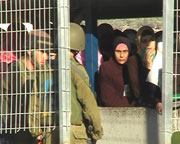
A man exits the checkpoint. He is a Nablus policeman. Everyday he goes
through this inspection. Life's tough, he says, re-clamping his belt.
Smiles at us. And bids us farewell.
A woman kneels after exiting the checkpoint. Perhaps to retie her
shoelaces as women appear to be ordered to untie them. Not here, the
soldier calls out to her from his vehicle-checking-preventing post
entering Nablus, and points his gun at the cars again. She straightens
up immediately, without retying her shoelaces, and leaves.
Taxi-van driver S. has been waiting for passengers for hours on end.
Livelihood is meager. I'll stay here until I'm thirty, he says, pained.
This is work? This is life?
The officer, showing his muscle on one of his rounds, says to S.: If you
stop smuggling explosives, that'll be good. And left.
S. comments to us: Who would carry explosives through the checkpoint…
Why don't you do this on your border? Why here...
A man exits and realizes he forgot a bag with sweets at the checking
post. He is afraid to go back and ask for it. He tells people around us,
and they turn to us, asking us to try asking the soldiers, for we would
not be harmed for asking. So we went to ask and the soldiers told us
there was no such bag there… He was not surprised nor obstinate, and
left...
People tell us the cell phones and money and wallets are often taken.
Say I place a wallet on the counter, and then I'm told the metal
detector bleeps and I go down, come back, take my wallet and leave, and
now it's empty. We come to the officer and tell him, he asks the other
soldiers, and they deny everything.
Someone says that on Thursday he had had cash in his wallet. He put his
ID on the counter. Bent down to tie his shoelaces. Straightened up,
gathered his stuff. Got out and – no money. He told the officer. But
they didn't return it.
A young, very lean 18-year old, comes out bent over and defeated.
Breathing deeply. Tells us they harassed him terribly. Drove him crazy.
A thousand times – lift your shirt, pant legs, coat inside out, again
same coat inside out, and the soldier scorning him and saying the young
man pretends not to understand. Saying, you don't understand Hebrew, but
nor Arabic. The young man said Ah, the soldier – contemptuously – That
you can say. Ah. Ah. Ah. That you know. And to pass explosives, that you
know too… Pretending, so that you can get a bomb through... And more of
the same until he let him go. He left, his face saying 'I don't believe
this is happening to me and I take it and keep silent…" Not much later
the same soldier came around who had scorned and humiliated him. We saw
he had an antenna on his gear, meaning he could be the checkpoint
commander. He chases S. and the others away. Not me. Mine is still the
'right' accent.
Everything alright? he asks me. I didn't answer.
A young man exits, swearing. His whole being reflects withheld
resistance. And pain. He places all his belongings on the concrete
ledge, moving tightly. Belt. Lighter. Notebook. Pencils. Looks angrily.
Handsome. Biting his lips. Fuckers, he says. Fuck them. Again and again.
Looking at the soldiers with hatred and rage.
He studies draftsmanship, he says. He had a folder with sheets of paper
and pencils. The soldier told him to show the paper sheets. Turning one
after the other. It was a block of blank sheets. Drafting paper. He
shows the soldier that there's nothing there. Nothing written. Brand
new. So the soldier tells him to show the pencils. And he took them out.
And put them back in. And the notebook again. And the soldier says, 'I
don't believe you that the sheets are blank.' Hinting they contain some
kind of code. Again he wishes to see the blank pages. All this in
Hebrew, which the student hardly understands, and later it comes out
this soldier knows Arabic, but spoke Hebrew on purpose.
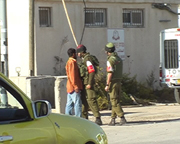
Two soldiers stand at the entry path into Nablus, and begin to demand
IDs. They hold a piece of paper with something written on it, which they
check. "Security" – the Occupation's sales slogan outside – is starkly
exposed here in all its vanity. They are inspected even when entering
the city of Nablus??
M., the 13-year old boy from Huwara has set up his meager goods again,
the upside down carton on which a few soft drinks and candy boxes are
displayed in the passage to the taxi park. The Burin boy gave up for the
day. A soldier arrives and chases M. away. A DCO representative. M. is
angry. His mouth trembles, tight. He tries to collect his things and all
the candies fall into the dirt. Those that remained after another
soldier had overturned the carton with his leg, this morning. After
seeing the boy's whole stock scattered on the ground, the soldier left
him alone and for some reason turned to me (I never saw him before) and
spoke to me as if we were friends, asking how I was.
I will not pretend innocence. I know why he turned to me. He assumed,
wrongly of course, that being of that very same privileged race as he
is, I necessarily exist on the same plane as his, belonging and
agreement and camaraderie of a certain kind. And from this place he
naturally assumed that I condone and respect him. Which, of course, is
not true. I have no sense of shared belonging with another person on the
basis of race or ethnicity or skin color or other such empty parameters
such as identity or history. And certainly my moral view of him is not a
function of this. I would see him neither as blameless nor as
non-criminal even if he were closer to me than just racially. His
deeds remain what they are whether or not he is a fellow national, or my
son, or my spouse.
In answer to his question, I said I feel very bad. Very much hoping he'd
leave me alone. Because I prefer not to talk with soldiers. I do not
validate their words wherever they are present as occupiers, for as such
they are not and cannot be the window into reality. Furthermore, out of
solidarity with the victims I do not care to dialogue closely with the
perpetrator, never mind why. For I feel that speaking with them - except
in protest - constitutes an act of callousness their victims. Anyway, he
asked why I felt bad and I said, because the checkpoint is still here.
And he said, but I'm here. I presume he meant – here in his capacity as
a DCO representative. Perhaps this very one. It is amazing that the DCO
is one of the most sinister, main, cynical tentacles of the Occupation
regime, acting jointly with the General Security Services. The DCO
maintains the guise of helping a civilian population, while in actual
fact it locates needs in order to prevent filling them. Like building
permits. Like permits for health reasons, or work. These are the very
grounds for prevention, and pressure to collaborate.
Anyway, I told him that the only good thing he could do is not to be
here. When he insisted that he does good, I insisted he does not. And
that the checkpoint – him included – is pure abuse, nothing else. His
face grew long and very offended.
In contrast with the willing calm with which a moment earlier he chased
away little M. and unhesitatingly prevented him from earning a pittance
to feed his family. Not as a metaphor, literally.
Then we heard that last Thursday (27. 3) around noon, a child and his
father who live in Beita came out of Nablus. (S. and the children A. and
M. are telling us about this, along with a few people we do not know.) A
soldier told the boy to lift his shirt, and he did. An 8-year old boy or
so. Little. He lifts his first shirt. Underneath he had another shirt,
green. The soldier went berserk, they say. Apparently because of the
green color (same as the Hamas flag). And the boy was scared of the
soldier so he began to shout to his father, daddy, daddy, and went over
to his father. And we had a hell of a mess, they tell us. The checkpoint
was closed down. They were shooting in the air. Just to frighten us.
And the child?
They took the child over there. Took off his clothes. A little kid like
that. Left him in his underpants. Standing here in his underpants. With
everyone looking. And no one to photograph this, that's the problem.
Over an hour.
And his father was waiting. They wouldn't let him talk to the kid. He
was standing here. Not arrested.
There was a jeep, they put the child in the jeep. And we were standing
in a line, near the vegetable stall, looking on. And a soldier came and
began to hit us from the back. We didn't realize this until he began to
kick us, like dogs. It was an officer. And he began to shout, and kick
with his leg. We were startled... what happened? Tell us to move, we'll
move. No need for such things.
They were there inside. Near the room. Where the door is. With the
child.
What do you think they did to the child?
I don't know. We left after more than an hour and he still had not been
released. The checkpoint was closed for about an hour, something like
that.
One of the children tells us that there were shots on Thursday evening,
too. At noon the little boy with the green shirt, in the evening an
adult. Someone who was really assaulted. He got beaten with a rifle butt
in the belly, until he totally bent over in pain and had to be taken to
the hospital.
A day before yesterday, too, S. tells us, on Wednesday, there was havoc.
Someone passed the metal detector which bleeped the first time, he was
told to go through again, and again and again, and had nothing. He took
out his wallet, took off his shoes, still the machine bleeped.
Apparently he had something in his teeth, gold or iron. But the soldier
wouldn't listen. And all the soldiers came at him, beat him up really
badly. His face was red like this shirt. A shame. His face was bleeding.
They were hitting over there. Boom, boom boom. With their legs, their
rifles, even with their rifles. Poor guy. In short, they treat people
like animals.
What about him?
They let him go after two-three hours.
What have we done to be treated this way? God help us.
The agitated boys tell us about more and more incidents. Last Friday, it
seems, colonists came over and stoned them, and the army came to chase
the vendors.
And then we see four soldiers from afar, near the stalls furthest from
the checkpoint. So we hurried over there. No need for stalls today, says
DCO representative Aiman to A. This was Captain Aiman, the vendors say,
who told them a while ago to move over to where they stand now, after
having sold their wares closer to the compound. But today they are
forbidden here, he tells them.
Vivi approaches Aiman and asks him to at least let hem finish selling
their stock. A. pleads with him. Another soldier, the checkpoint
commander (with antenna) already mentioned here, hearing Vivi, tells her
'I don't give a damn about you.' A. asks Aiman again. Aiman asks the
commander. They whisper a bit, then he tells A. – okay, just move over
here to the steps, nearer the checkpoint. So they moved him from a spot
further off to a spot nearer the checkpoint. From where – for that
proximity reasoning – the children had earlier been removed for being
too close.
So the question is why can he not be where he is? And why suddenly close
to the steps? Where others were removed earlier? Because he is there and
not here, that's why. Because the point of it all is pure harassment,
denial of livelihood and food, attrition. That's why.
In the meantime A. has taken his flowerpots and somehow placed them near
the steps close to the checkpoint. And everything drops and is scattered
on the ground. The soldiers continue chasing away the rest of the
vendors. Then they reach the edge of the taxi-park, a shed built outside
the compound, covered by a blue tarpaulin, belonging to the little Burin
boy's aging father. These days he only sells greens and parsley there.
It is also a resting spot on the way. One of the soldiers begins to cut
the shed's bindings with some cutters, and it begins to collapse.
A man comes pleading, only two bags of beigels left, take them… everyone
begs to just finish the day's stock.
Get out of here, split! the soldiers are heard. Go on. No stalls today.
Vivi photographs the dismantled shed. The commander approaches her close
and fast, his motions threatening. I'll break your camera, he says.
You'll break her camera? That's what you say? I say. He snorts. Get even
closer to Vivi and with a threatening gesture, begins to push her, his
rifle onto her, his chest thrust forward, his face tough and scornful.
What are you ashamed of? asks Vivi.
After all, you are proud of what you do. If you are ashamed, don't be
here, I tell him.
Slowly the shed collapses and falls. Part by part. The blue tarpaulin is
already rolling on the ground.
Why? the child asks, upset.
People surrounding the spot are very agitated about the destroyed shed.
Children and women stopping by stand staring at this act of stark
vandalism, and meanwhile the father of the child from Burin –owner of
the shed - has returned, and is stunned. He was not even selling there
at the time, had just returned all the stock that was left to Nablus. A
soldier who realizes who this is tells him: take apart this shed,
otherwise I lay you on the ground and blow your head to bits.
The shed was beyond the fence, not on any pavement, as they claimed. And
even if it were, so what? What crime is this elderly man guilty of that
soldiers – lawfully and normatively – destroyed his source of
livelihood? What will his eleven children do? What do these young brutes
think as they carry out these sinister orders, which apparently exist as
such? So what if these are orders or norms? Can one really argue that
this is not their personal responsibility because they are mandatory
conscripts? Because these are their instructions?
And would Jews' stalls be destroyed so easily, so flippantly, so
willingly, and tramped with army boots? Would Jewish children's candy be
allowed to roll in the dirt, children thus trying to make a few pennies
to feed their families? Would a Jewish child trying to sell bread be put
in a cage?
Every time they destroy his stall, the Burin father says, suddenly
looking terribly tired and sad. All present are now looking at the
nearly fully collapsed shed. He tells us how he tried to sell vegetables
on the other side of the Checkpoint, going into Nablus, because here his
goods were always being destroyed. And on the way to an army incursion
in Nablus, they moved intentionally on the roadside and destroyed his
cart and his shed and his scales with their Hummer. Trampled everything.
This happened five months ago, so now he is here again.
Why do you do this, I asked Aiman.
Let me explain to you. It disrupts their life fabric.
It doesn't bother them (the Palestinians), I said.
Yes it does. You don't live here. I live here, he said. Some people
asked…
What?
Naturally not the vendors, he explained… Say a taxi comes in, it creates
a disturbance.
But they are on the sidewalk! said Vivi.
Forget it, you don't live here, he said. It's not the sidewalk, it's the
road. People get run over. It's people's life fabric.
Who gives the order? I asked.
Never mind, he said.
I want to know because I want to lodge a complaint. I think it's wrong.
It's terrible.
Don't get confused here. I'm letting you figure this out.
Is it you, on your own, are you following orders? I asked.
My buddies from Thailand thought it up, okay? Not me. What do you care
who thinks this up? There are orders. There is an army. It decides.
Are these the army's orders?
Yes.
Okay, I said.
Okay?
That's what I wanted to know, I said.
Okay. Thanks. Don't bug me. I'm here to help them.
You're not here to help them, I said.
Oh, really? Are you?
Yes, I said. Even though it's not the whole truth. I'm not here to help.
I'm here to protest. And say no. And say this is criminal, this is
abuse, and no. Not under any circumstance, not relatively. Just plain
no. And not help it in any way, or serve it. Just say no to this evil
No.
You don't know about these things, he said.
Forget it, I said. I don't want to carry on a lengthy conversation with
the occupier, certainly not while occupying in practice, and in full
view of the occupied.
Don't argue with me, he said. What's your name?
I don't want to tell you. It's none of your business, I said.
I'll take care of you and you, both of you, big time. When I'm back at
the office I'll call your superior. I'll take care of you. It just
cannot work this way. I know what to do. I'll complain to your superior.
Young men standing by ask 'why does he talk to you this way?' I tell
them that it's because I told him what I think of what he's doing. That
he's doing something very bad. And whoever is bad, speaks bad.
What did he say? they asked. He said he'll give me trouble, I said. I
also said he says he's doing it all for the benefit of people here.
And they all burst out laughing.
Three women looked on, disgusted. What a shame, they said. What a shame.
There were a few filled plastic bags next to them. They are from Balata
refugee camp. Working in the Barkan colony, cleaning houses. Lots of
work before Passover, even on the Sabbath. Their bodies and faces
reflect their commiseration with the goings-on. The shed is nearly fully
collapsed. The little child paces restlessly. Horrible poverty emerges
everywhere, heart-breaking.
Nearly every night, they tell us, soldiers come to Balata refugee camp
homes. They come in. Scatter the sugar and oil and flour. Hit children.
Standing them all outside until they finish rummaging and turning
everything upside down or searching. In the cold and rain. Even
one-month old babies.
One woman is crying. The shed is totally ruined. The children are
terribly upset.
Then soldiers start yelling at us from the checkpoint to go away. That
the checkpoint is closed. Go away, the soldiers – men and women – yell
roughly, chasing everyone away. People back off. Crowding together. This
is a maneuver, someone explains.
It's like this every day. They close the checkpoint for 15-20 minutes,
as if catching someone… Like playing a war game.
The commander who pushed Vivi previously sees her again, and pushes her
saying "Go away, you rag!"
The Palestinians are aghast at this. It's enough that he said things,
one of the drivers says, but to push you!
Vivi tries to play down the scene. For she knows that whatever she
undergoes is marginal, is minimal, is still within her privileged
position, her 'right' race. And that she will not pay a real price nor
run a real risk and her situation and privilege is incomparable with
those who found room in their hearts to identify with her, (daughter of
the occupying nation), and be shocked for her.
We are both very moved.
From what garbage dump were these soldiers taken, someone asks. We nod
in agreement.
But it's not these particular soldiers. They are not the exception.
These soldiers just like others before them, these are soldiers doing
their duty. They check, or so it seems. They prevent. They abuse. That
is what they do. That is what they were sent to do. Because that is what
being a soldier means. There are variations respective of their personal
temper. One abuses 'courteously', another 'roughly'. These are
variations on the same theme.
Thus, now, for years, in various checkpoints, various army units,
various ages – soldiers abuse vendors and deny them their livelihood, by
law and custom.
For that is what being a soldier means.
The soldier Aiman told the father of the child from Burin, your child is
not good. The child said, why am I not good? I am just trying to defend
my rights. I told him he is a charming child, because he is charming,
and I sewed my tears up tight.
It is very important for him, he explained to us, that we understand his
standing upright facing the oppressors, because that is what should be
done, and he has not committed any crime whatsoever.
If he could only join his school trip to Jericho on Wednesday, which he
told us about previously, if the army will let them through.
The white jeep with soldier Aiman and his two mates look at the rest of
the stock scattered on the pavement, make sure everything has indeed
been destroyed and dismantled 'properly', 'by the book', for a few
moments. Then they left.
Vivy Sury and Aya Kaniuk reporting. Translated by Tal Haran |
|